Newsweek Magazine recently ran a cover story in it's February 21st edition, which read "Egypt : How Obama Blew it"
The editor takes great pains to prove that Obama's strategy of wait and watch has left America neither here nor there in its battle to win the moslem world. America, according to him, should have extended a hand to the revolution and done more to edge Mubarak out.
Surprisingly the editor ignores a few of the salient points of American Foreign policy. To start with, (Noam Chomsky would definately concur with this) Americans have always propped up puppet regimes all over the world that serve their vital interests. In the Middle East, the objective was mainly to ensure that the price of oil was stable (or the price that they could buy it from the market was stable).
Indeed the bogey that western-sponsored dictators are any day preferable to hardline fundamentalists, worked for a time and served its purpose. The Obama administration was indeed caught by surprise and on the wrong foot especially when it had to choose sides in the Egyptian Revolution. On one hand, if it threw its weight behind the faceless revolution, other pro-US regimes in the region would have wilted causing more instability.
If it had ignored the protests it would have been taken to task for not practicing what it preaches. A few years ago when Iraq was forcefully overthrown, America had trumpeted it as the dawn of a new age of freedom and democracy for the Arab world. Iraq it seems was not the actual freedom struggle waiting to happen.
Obama and the Secretary of State's carefully calibrated reply reflects the changing contours of American Foreign Policy. Here is a government that could be relied upon to extensively lobby the United Nations into action, but act unilaterally they will certainly not (unlike the previous administration)!!
The case of the Libyan uprising however does make things a lot easier for the US to act. A tyrant with a large sovereign wealth fund who has no qualms about bombing his own people only to secure his throne is an ugly picture for all. The US administration should encounter little opposition when pushing the UN for Action. Howbeit, there will be other spoilsports in the game such as China or Russia who would have their own interests to see to.
This is probably the best shot the US may get to stand with the values it preaches, but they should rope in the UN. Acting unilaterally is indeed the way forward no matter how painstakingly slowly things move. The world community needs to act as a whole, the US can ill afford to be sucked into another war.
First posted on Technorati
In a Jail cell, Jodie Foster who plays an FBI Investigator tries to interrogate a psychopath, played by Anthony Hopkins in a scene from the 1991 award winning movie The Silence of the Lambs. As the back-and-forth dialogue intensifies, the prison inmate leads the FBI agent down a path into the most basic of human natures. Read On:
Hannibal Lecter: First principles, Clarice. Simplicity. Read Marcus Aurelius - of each particular thing ask: What is it in itself? What is its nature? What does he do, this man you seek?
Clarice Starling: He kills women...
Hannibal Lecter: NO. THAT IS INCIDENTAL!! What is the first and principal thing he does? What needs does he serve by killing?
Clarice Starling: Anger, um, social acceptance, and, huh, sexual frustrations, sir... Hannibal Lecter: NO! HE COVETS !! That is his nature. And how do we begin to covet, Clarice? Do we seek out things to covet? Make an effort to answer now.
Clarice Starling: No. We just...
Hannibal Lecter: No. We begin by coveting what we see every day. Don't you feel eyes moving over your body, Clarice? And don't your eyes seek out the things you want?
In some form or fashion, we all covet. We yearn for things we see most of the time, we lust for the finer spoils of life, to be seen sleepless in the corner office, and to be heard rambling on television. We wouldn't mind surmounting countless boulders with a timeless zeal oblivious to the parched earth on which our tender feet are being forced to tread on. In the end, while basking aloft on the summit we realize that much of the joy is actually behind us.
Despite this, there are those who desire that which may just prove to be a shade better than what they already possess. They throng their nations capital city squares, maraud government property and have given the age-old crime called arson a new human face. Much of this and even more is all fodder for an over-hungry press ever too willing to cover just about anything.
CNN's Anderson Cooper may have taken a few blows on his face a fortnight ago on the streets of Cairo when the uprising in Egypt reached its zenith, but the real fight may be around the corner, maybe 6 months or a even year away. The main opposition party in Egypt - the Muslim Brotherhood is lying low right now biding its time, waiting for the opportune moment to reveal itself.
Meanwhile as the rest of the Middle East progresses from simmer to boil, Egypt flounders on uncertain of what the future may hold. For the moment though, the military is in charge, though history shows that in most cases, the men in forest green rarely give up the throne without a scuffle of some sort.
What about Libya? There is no doubt whatsoever that these dictators have indeed led their nations down the path of fiscal ruin. The numbers will surely tell you the story; almost 25% of Egypt's youth were unemployed when the riots began.
However, the fundamental question actually is:
"Is democracy the real answer to the regions ills"?
Democracy works to perfection, albeit with a few odd chinks in its armor. Some of its most important facets are the systems that protect the rights of the silent majority and even at times, halt the cries of the bloodthirsty steamrolling majority. Most Arab countries have structures that have flourished over time with a nexus between the oligarchy and the Global Financial Systems with little or scant regard to social issues such as these. The majority were permitted to languish while the rich became richer.
Now, the Arab Nations have chosen the path of the uprising for all the right reasons.
If one were to look a little harder, one can clearly distinguish the fact from the current frenzy. The truth is that they covet Democracy but do not covet its freedoms!! Most of the Arab world detests the freedoms that Western democracies offer to minorities. There are laws in the west that permit abortion, then there are laws against gender discrimination, sexual discrimination and many other forms of discrimination that folks in the Arab world wouldn't even pay heed to.
They covet what they see in the west, for lifestyles that appear fanciful, for streets that are paved with gold or just for its sheer sheen. Their path to democracy would regardless of the road they choose, be a tortuous one. They would pick and choose the bad apples to discard from the policy basket. Minorities would meanwhile live in temporary fear while the majority by and large may just choose to wield their pitchforks every now and then, so as to ensure that despite the freedom to choose, they still have the major say.
The engines of Change have begun to crank, more regimes may fall, but more blood will certainly be spilled.
First Posted on Technorati
The "Train to Pakistan" was one of those memorable brief novels written in the fleeting haste of the bloody India-Pakistan partition war set in the 1950's. It was a time when the subcontinent was psychologically ripped into 2 eternally contentious halves after collateral damage of approximately 6 Million lives all swearing by various deities.
The hordes of Muslims who hurriedly crossed over to Pakistan did so mostly for the sake of their religion. Shortly after Pakistan got its name, its founder Muhammad Ali Jinnah in his first presidential addressed to the nation slipped the following quote through amidst the celebrations: -
"You are free; you are free to go to your temples, you are free to go to your mosques or to any other place or worship in this State of Pakistan. You may belong to any religion or caste or creed that has nothing to do with the business of the State".
Half a century ago; actually, not too long ago, Pakistan did have a Center. They were mostly subcontinenters brought up with a British education and more westward leaning. The Radical streak entered the system with the unlawful entry of General Zia Ul Haq and his troupe in the 70's. From then on, his legion of radicals and hard-line generals began to smudge the existing fine print in the cultural establishment. Slowly the base of tolerance began to erode. Blasphemy laws draconian in nature were laid down.
Over the years the state of Kashmir became a central issue to Pakistani politics. This illegitimate intifada against India was supported to largely on a clandestine basis by the ISI (Pakistans Intelligence Agency). This gifted the generals unquestionable power and leverage in the political establishment. They could depose governments at their own whims and fancies.
At the turn of the century, 9/11 happened, and then suddenly Pakistan found itself at the epi-center of America's fight against terrorism. Ordinary Pakistani's had to contend with a military ruler and his regime gunning down their own home-bred extremists in their own backyard, so that Uncle Sam and his children could tuck themselves to sleep miles away. Obviously this did not win America any brownie points with normal Pakistani's.
Then came the last straw. The Deluge in 2010, that washed away 20% of the country's arable land. Homes were drowned, tens of thousands were displaced and are still living on handouts. Whatever aid that came from the International community was painfully slow. To make matters worse, the Islamic Terrorist groups stepped into the muddy waters and started offering aid thereby cementing their position as guardians of the people and isolating the government even further.
By now, the size of the Center in Pakistan had shrunk to the size of a fist. How could ordinary Pakistani's even think of imbibing the virtues of their most dreaded enemies? The Middle was hence won over to the Right, and whatever was left of the liberal camp had to be contended with whispers in their tents.
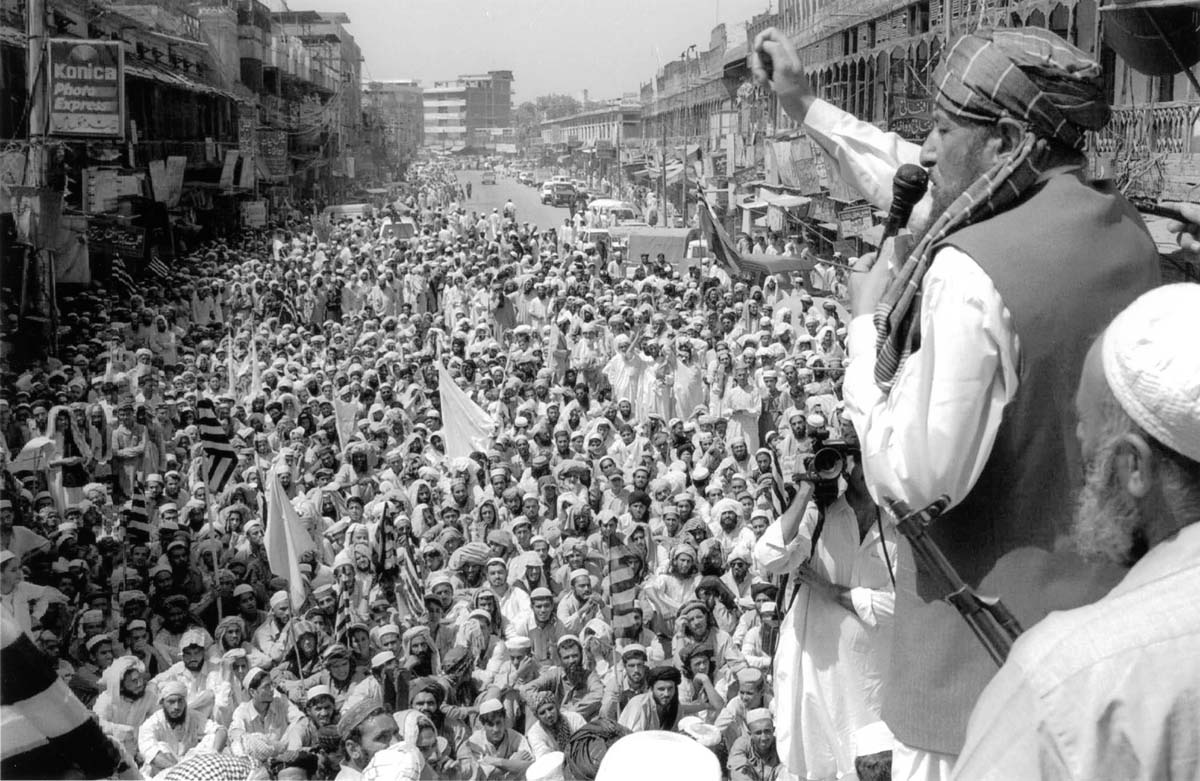
Last month the Governor of Punjab Province, Salman Taseer, someone who was bold enough to take on the religious right was gunned down in broad daylight. To add insult to injury, hordes of individuals on the streets, including the patrons of freedom in Pakistan, the lawyers, praised the assassin - Hussain Qadri for his deeds. By now, the liberals had gone into hiding.
It is no surprise that tourism in Pakistan had dropped considerably in the past few years. The Swat Valley, known for its marvelous picturesque views is now a barren land plagued by the occasional rattle of the machine-gun. Drones hover deep above their clear skies spying for suspicious activity on the ground.
Yet, in this chaos, more trains and even busses ply to Pakistan from India as hopes rise for a peaceful solution. Tourists however are staying off. As the nation sinks deeper into radicalism and fundamentalism, backpackers will keep-off, holidayers will prefer to see Shalimar gardens on youtube while the children of the soil may begin to see Birmingham as their first home.
First Posted on Technorati
Last week at the State of the Union Address, President Barack Obama waxed eloquent as he spurred his countrymen on to embrace what he referred to as this generations Sputnik Moment.
Thousands of miles across the Atlantic a different set of people seem to have picked up the drift. As tens of thousands of frustrated youth throng the streets of Cairo and Alexandria demanding the ouster of their leader, Mubarak's silence is indeed deafening. The Egyptians demands are as genuine as the Tunisians. Corruption, joblessness and a whole host of other ailments that have been simmering over the past 30 years are now coming to a boil on the scorched crowded streets of Cairo.
It is however interesting to note the caution with which world leaders are treading.
Firstly, President Hosni Mubarak has NOT addressed the nation yet. Of course, it is assumed that as the crisis worsens, he would eventually make some sort of televised address. For the moment though, he chooses to live in ignorance. He is biding time hoping that sooner or later the mobs will get tired, and the protest would loose steam. In fact, in some circles he is even being termed as "arrogant" by announcing the post of a vice president when the country is screaming for his head. Like a poker player he is holding his cards close to his chest and waiting for the other players to call!!
The other player at the table is the US. At stake is a strategically located ally headed by a more-or-less puppet regime which gets 2 Billion dollars in aid receipts annually. Why risk a known friendly neighbourhood dictator for an unknown liberal with an unknown agenda? America has enough on its hands with Iran and Afghanistan. So while America may pay lip service to democratic ideals, secret parleys with Mubarak are certainly underway to untangle the crisis.
Nearly 10 years ago, in 2002, Professor Amy Chua from Yale University published her first book "World On Fire", against the backdrop of the riots in Indonesia against successful ethnic Chinese by a more than a few truckloads of jobless islanders. She made a few valid points about some of the undesirable aspects of Democracy and Globalization at a time when the likes of Thomas Friedman were singing its praises.
Democratic uprisings often place tremendous power and leverage in the hands of rampaging mobs that desecrate everything in their path with impunity. The case of Iran stares glaringly in ones face as an uprising turned sour. Isolated from the International community and a source of constant tension in the middle east, Iran were clearly better off with the Shah, but the Iranians didn't clearly think so.
However in this case, the uprising isn't religion based. The other party at the table, the Muslim Brotherhood is tactfully circling the skies waiting for the mobs to clear the streets in order to swoop down and lay claim to whats left of the revolution.
The 4th player on the table, the one with the most visible might is the army. Loyal to President Hosni Mubarak for all these years, the army has done a u-turn and refused to clamp down on the masses. This has allowed the protests to gather more steam. If at all any party can grab the reins here and set the tone, it is indeed the army.
Between all these players, lie the legitimate cries for regime change. The once timid Egyptian public has finally arrived at the table are anxiously waiting for action. The players are however nervously passing the buck for everyone else to make the first move in order to retaliate. In such an environment predicting the end result becomes a Permutation formula.
Things however may not go as badly as one thinks. Egypt is after all fashioned in the similar mould as Turkey is with a large liberal base. Most Egyptians do not favour a return to war with Israel (a scenario that may happen if the Islamic Brotherhood comes to power and decides to scrap the peace accord). A smooth transition by the army to a new administration may yield the much needed reforms needed to boost growth.
Egypt could still stake its claim amongst the most successful yet liberal Muslim nations of the world such as Turkey, Malaysia, etc .. but this certainly will not happen overnight. On the streets, the last tyre is yet to be burnt and the shutters are still half open. The smell of change is ripe in the air. This may after all still prove to be the Saracens Sputnik moment.
 The editor takes great pains to prove that Obama's strategy of wait and watch has left America neither here nor there in its battle to win the moslem world. America, according to him, should have extended a hand to the revolution and done more to edge Mubarak out.